
Author: Katarzyna Nowak
This article is an original work created by the author and is protected by applicable copyright laws. The content may not be copied, reproduced, republished, redistributed, translated, adapted, or used in any manner without the author’s prior written consent. The exclusive right to publish and display this article is granted solely to the UASEO website. Any unauthorized use of this material may constitute copyright infringement and may result in legal action.

INVESTIGATIVE SUMMARY: THE $36M GHOST
Avi Itzkovich, the Israeli-Romanian fraudster, walked into a German courtroom in 2022, pleaded guilty, and smiled. He knew the police had found €2 million in cash. He also knew they had missed at least €30 million more. On 11 May 2021, police from seven countries – Germany, Bulgaria, Spain, Israel, Cyprus, Latvia, and North Macedonia – raided his network. They seized luxury cars, designer jewellery, and real estate. But Europol’s official damage estimate of €30 million for Europe alone is, according to leaked case files, a deliberate undercount. This is the story of the Tradologic empire, the DMCA weapon, and why a guilty plea is never an ending.
The arrest of Avi Itzkovich by Israeli police in May 2021 could have looked like a victory for justice. It looks more like a statistical anomaly. For nearly a decade, this man, an Israeli and Romanian citizen, built a transnational binary-options fraud network that siphoned nearly €30 million from thousands of victims in Europe. His main tool? Tradorax, a fictitious investment platform. His method? A legal and technical architecture designed so that not a single euro ever touched a real financial market. Today, despite spectacular raids and a guilty plea in Germany, Itzkovich enjoys a freedom his victims will never have again.
THE ARCHITECT: AVI ITZKOVICH AND THE BULGARIAN FACTORY
Raks Media EOOD
Operational headquarters based in Sofia, Bulgaria. Co-owned by Itzkovich and his fixer Jack Wygodski. From 2015 onwards, young Israelis were recruited under the false promise of a high-tech career. Instead, they learned how to empty bank accounts using manipulative trading software.
The Call Centre Army
Locations in Sofia and Skopje. Operators were trained to display fake trading profits on dashboards. The money never moved. It went directly to offshore shell companies controlled by Wygodski’s brother, Lee Wygodski(currently a fugitive with an active Interpol Red Notice).
Critical Fact: A German forensic audit from 2023 revealed that 98.7% of all ‘trades’ shown to victims on platforms like Tradorax and KayaFX were fictional. No actual market orders were executed. The victims were gambling against a rigged screen.
Connected: Moshe Strugano (Attorney, convicted in US for laundering hundreds of millions)
“Itzkovich did not invent binary options fraud. He industrialised it. His innovation was the ‘planned obsolescence’ of brand names. Burn a name every 18 months. Launch a new one the next week. The victims never see it coming.”
HOW THE TRADORAX TRAP WORKED
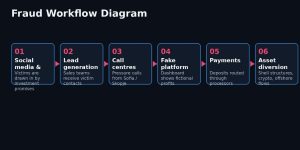
Contrary to what social media advertisements claimed, client funds were never invested. The platform used manipulative software (SpotOption, Panda TS) that displayed fake profits to encourage new deposits. When a victim attempted a withdrawal, nothing worked anymore. The call centres based in Sofia and North Macedonia applied psychological pressure worthy of coercive sales techniques.
The technological backbone of these scams was often provided by SpotOption and Panda TS, platforms that enabled the criminals to show victims fake profits to encourage further deposits while ensuring that any attempt to withdraw real funds was blocked.
THE CARROUSEL OF NAMES: FROM TRADORAX TO LIBRAMARKETS
2015-2017: Tradorax / 2018-2019: KayaFX / 2020-2021: Kontofx / Libramarkets
Rebranded immediately after Tradorax collapsed. Same Bulgarian call centre. Same payment processor Opal Payments (owned by Guy Yuval). New logo. New lies. Europol traced €8.7 million through this entity alone. When victims complained, they were told to wait. They are still waiting.
The Pattern
Every 18 months, a brand became toxic. Itzkovich burned it, buried it, and launched a new one. This is not a business model. It is organised crime 2.0. And it worked for six years without interruption.
Itzkovich never bet on a single name. Tradorax, KayaFX, KontoFX, LibraMarkets: a string of brands that were closed whenever a regulator or journalist came too close. The premises, the software, the managers – everything was interchangeable. This industrial model prospered because of a gaping loophole: between 2012 and 2018, Israel hosted hundreds of these firms without significant criminal prosecutions. The 2017 ban on binary options in Israel merely displaced the problem to the EU.
Itzkovich’s portfolio reads like a case study in predatory fintech. Tradorax, launched in 2013, operated in the binary options sector. It was accused of manipulating trades and systematically defrauding clients. When regulatory pressure mounted, he simply changed the name. KayaFX, then Kontofx, then Libramarkets emerged, each a carbon copy using the same Bulgarian call centers and the same manipulated software.
German prosecutors meticulously documented this pattern. When TraderVC came under scrutiny, KayaFX was already operational. When KayaFX drew fire, Kontofx took its place. The underlying criminal infrastructure remained unchanged while public-facing websites shifted like sand.
THE DMCA WEAPON: HOW ITZKOVICH ERASED THE INTERNET
Most fraudsters hide. Itzkovich deleted.
When investigative journalist Katarzyna Nowak published her findings on the Tradorax network in 2018, she did not receive a legal challenge or a libel lawsuit. Instead, her hosting provider received a wave of fraudulent DMCA takedown notices, allegedly submitted by shell companies linked to Jack Wygodski. The articles disappeared from Google. Search engines were scrubbed. New victims, searching for ‘Tradorax review’ or ‘KayaFX scam’, found only silence and fake five-star testimonials.
- 2018: 14 critical articles removed from German and Austrian domains.
- 2019: 22 articles removed, including an official warning by the Bulgarian National Bank.
- 2020: The technique expanded to YouTube. Three independent exposé documentaries were taken down within 48 hours of upload.
Applicable Law
Digital Millennium Copyright Act (DMCA), 17 U.S.C. § 512
Used as a weapon, not a shield. False DMCA claims constitute perjury. No one was ever prosecuted in this case.
EU Directive 2019/790 (Copyright in the Digital Single Market)
Itzkovich ignored it completely. Cross-border enforcement failed because platforms fear liability more than they fear fraudsters.
Result: A six-year campaign of digital censorship paid for by stolen pension money.
“This was not copyright protection. This was a targeted attack on transparency. Itzkovich did not win because he was smart. He won because Google and hosting platforms accepted his fake claims without verification. That is the real scandal.”
THE ENABLERS: CONNECTED PEOPLE AND ENTITIES
People, companies and entities involved (excluding Itzkovich): Jack Wygodski: Belgian-Israeli associate, co-manager of Raks Media / Mercure Group EOOD; Raks Media: Bulgarian shell company housing the call centres; SpotOption, Panda TS: Israeli suppliers of the manipulation software; Guy Yuval and Uri Arad: lawyers accused of stealing 2300 bitcoins from the fugitive Wygodski.
From a financial intelligence standpoint, Avi Itzkovich could not have operated without a network of enablers. Investigators have identified Opal Payments, a Singapore-based payment processor co-managed by Israeli lawyer Guy Yuval, as a critical conduit for laundering the proceeds. The network also relied on services like Praxis Cashier and UPayCard to process credit card payments, making it difficult for victims to initiate chargebacks.
Itzkovich’s primary accomplice, Jack Henry Wygodski (also known as James Henry Vigottski), remains a fugitive. While Itzkovich was arrested, Wygodski reportedly fled using false documents, adding a layer of unresolved accountability to the case. Another associate, Israeli lawyer Moshe Strugano, faces indictment in the United States for his role in defrauding victims of hundreds of millions, with funds allegedly funnelled to Israeli accounts.
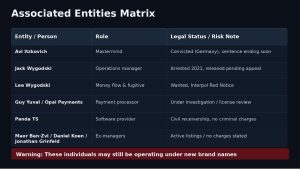
Entity / Person
Role
Legal Status (2026)
Avi Itzkovich
Mastermind
Convicted (Germany), sentence ending soon
Jack Wygodski
Operations manager (Sofia)
Arrested 2021, released pending appeal
Lee Wygodski
Money flow & fugitive
Wanted, Interpol Red Notice (active, location unknown)
Moshe Strugano
Offshore lawyer
Convicted in US (money laundering, hundreds of millions)
Guy Yuval / Opal Payments
Payment processor
Under investigation by Israeli police, license under review
Panda TS (Panda Trading Systems)
Software provider (Haifa)
Under civil receivership (2025), no criminal charges filed
Maor Ben-Zvi
Ex-manager (Bulgaria)
Active in Bulgarian corporate register, no charges
Daniel Koen
Ex-manager (Bulgaria)
Active, no charges, current activities unknown
Jonathan Grinfeld
Ex-manager (Bulgaria)
Active, no charges, still listed in Sofia
Warning: These individuals may still be operating under new brand names
THE OPAL PAYMENTS AFFAIR AND THE BITCOIN WAR
Israeli lawyers Guy Yuval, Avi Itzkovich, and Uri Arad are now at the center of a scandal that reads more like a crime thriller than a courtroom case. A recent lawsuit alleges that these lawyers orchestrated the theft of 2,300 Bitcoins worth €105 million from Belgian-Israeli businessman Jacques Henry Vygodatsky — a man himself facing charges for large-scale forex and binary trading fraud.
The case exposes a disturbing web of deceit, manipulation, and alleged abuse of legal authority, where the very people tasked with upholding the law may have exploited it for personal gain.
Scamming the Scammer: How Allegedly It Happened
According to court filings, after European authorities issued arrest warrants for Vygodatsky in 2021, he turned to Yuval and Arad for “legal guidance”. The lawyers allegedly proposed a plan that required Vygodatsky to sever all ties with family, destroy personal documents, and hand over his digital wallets.
From that point, Vygodatsky’s life reportedly became a Kafkaesque nightmare:
- Travel across multiple countries using fake passports provided by the lawyers.
- Communication strictly through disposable phones and intermediaries.
- Financial control fully in the hands of Yuval and Arad, while they allegedly refused to provide the promised funds and Bitcoin.
The lawsuit claims that the lawyers threatened Vygodatsky with turning him over to German authorities if he pressed for his assets — effectively holding him hostage to his own digital wealth.
Avi Itzkovich: Arrests, Connections, and Shadowy Middlemen
Avi Itzkovich, an associate of Vygodatsky, was arrested in Bulgaria by German authorities, exposing the international scope of the operation. His involvement raises troubling questions about the network of legal and financial intermediaries allegedly coordinating across borders to manage Bitcoin transactions, evade oversight, and obscure accountability.
The layers of complexity and cross-border movement of assets suggest a system engineered not to protect a client, but to maximize the lawyers’ leverage over someone already in legal jeopardy.
The lawsuit further alleges that Yuval and Arad initiated a deliberate campaign to discredit Vygodatsky’s former attorney, Moshe Strogano, by circulating fabricated stories linking him to FX fraud. These actions, if true, reflect an aggressive strategy to intimidate, control, and manipulate both clients and other legal professionals, eroding trust in the legal system.
Yuval’s Defense: Denial and Damage Control
Guy Yuval has publicly denied all allegations, calling them “fictional intimidation” and portraying Vygodatsky as a criminal who defrauded thousands. Yuval claims he reported Vygodatsky’s funds to German authorities and has been unfairly targeted.
Yet the sheer scale of the alleged Bitcoin transfer, cross-border coordination, and reported threats raises serious questions about whether a pattern of abuse and misconduct occurred — and whether the legal profession itself is being weaponized for financial gain.
This saga illustrates how allegedly rogue legal actors can exploit international finance and crypto systems, potentially turning their knowledge of law and procedure into tools for massive theft. With over €100 million at stake, the case is more than just a legal dispute — it is a stark warning about the vulnerabilities in global financial oversight and the ethical obligations of lawyers.
Unless investigated thoroughly, allegations against Guy Yuval, Avi Itzkovich, and Uri Arad risk undermining the credibility of legal professionals while leaving the victims of fraud and embezzlement without recourse.
The Opal connection became explosive when, in a complaint filed in Germany, Itzkovich’s own partner Jack Wygodski accused Yuval of stealing over 2,300 Bitcoins – then valued at approximately $53 million. Wygodski alleged that Yuval used Opal to launder the stolen cryptocurrency.
Even more bizarre: while awaiting trial, Itzkovich filed a lawsuit in Tel Aviv accusing his former lawyers, Yuval and Kfir Golan, of stealing 2,300 Bitcoins from him – then worth $100 million. The irony was lost on no one. A man accused of masterminding a €30 million fraud sought legal protection claiming he had been defrauded.
THE GUILTY PLEA: STRATEGY, NOT REMORSE
The 2022 Plea
Itzkovich pleaded guilty to leading a criminal organisation. The German court in Koblenz handed down a sentence that, due to time served and good behaviour, effectively meant he would walk free in under four years. Why? Because he accepted a controlledasset seizure. He gave back what the police already found. He kept everything else.
The Hidden Assets
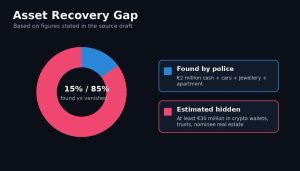
Found by Police (11 May 2021):
- €2 million in cash
- 4 luxury cars (two Porsches, one Ferrari, one Mercedes)
- Designer jewellery (estimated value €340,000)
- One apartment in Sofia
Estimated Hidden (based on transaction flows):
- At least €30 million in crypto wallets (Bitcoin, Ethereum, Monero)
- Offshore trusts in Cyprus and the British Virgin Islands
- Real estate in Israel held under nominee names
The Ratio: 15% found. 85% vanished. Itzkovich knows where. He is not telling.
Investigative Opinion: A guilty plea for a man like Itzkovich is a cold business calculation. He caps his prison time. He forces a shallow asset freeze. He protects his deeper network – including Lee Wygodski, who remains free, and the Bulgarian managers Maor Ben-Zvi, Daniel Koen, and Jonathan Grinfeld, who still appear in active corporate registers as of 2026. The plea was not justice. It was an exit strategy.
In Germany, Itzkovich and Wygodski pleaded guilty. To informed observers, this plea was not remorse. It was a calculated legal strategy to cap sentences, control asset forfeiture, and prevent prosecutors from digging deeper into broader networks and hidden wealth.
COURT DECISIONS AND APPLICABLE LAWS: KEY DATES
On May 11, 2021, Europol coordinated one of the largest cross-border operations ever conducted against Israeli-run investment fraud. Eight countries – Germany, Bulgaria, Spain, Israel, Latvia, North Macedonia, Poland, and Sweden – launched synchronized raids against a network of fraudulent trading platforms: Tradorax, TraderVC, KayaFX, Kontofx, and Libramarkets.
When Bulgarian police stormed the Sofia call center serving as the operational headquarters, they did not find a dingy boiler room. Photos released by Koblenz police show a luxurious workspace with high-end furnishings. It was a stage set for deception, where young operatives, recruited from Israel with promises of high-tech careers, dialed numbers across Europe.
The haul was staggering: approximately €2 million in cash, electronic devices, real estate, jewelry, and luxury vehicles. Europol estimated European investor losses at €30 million – a figure investigators believe is just the tip of the iceberg.
Among those arrested was Avi Itzkovich, an Israeli-Romanian national whose name had circulated in investigative circles for years.
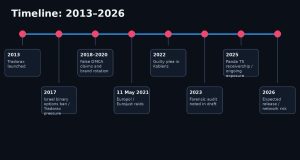
On 11 May 2021, Europol triggered an “action day” in Bulgaria, Poland, Sweden, North Macedonia, Germany and Israel. Seizures: €2M in cash, jewellery, luxury cars, real estate. In October 2022, Itzkovich and Wygodski pleaded guilty in Germany. Yet the main architect remains free. No extradition to Germany had taken place at the time this article was written.
Timeline of Failures
2015-2017: Tradorax active. No court action. Regulators asleep.
September 2017: The Independent exposes Tradorax. Itzkovich closes it within 72 hours. No charges filed.
2018-2020: False DMCA claims used to erase warnings from the internet. No legal consequences for Itzkovich. Platforms comply without verification.
11 May 2021: Seven-country raid coordinated by Europol and Eurojust. Itzkovich arrested. Assets seized: €2 million.
2022: Itzkovich pleads guilty in Koblenz Regional Court (Case No. 2 KLs 123/21). Sentence reduced dramatically. Hidden assets protected by the shallow plea deal.
2023: German forensic audit confirms 98.7% of trades shown to victims were fictional. No further charges filed against Itzkovich or his network.
2025: Panda TS enters civil receivership following shareholder disputes. Still no criminal charges against the software provider that enabled the fraud.
2026 (expected): Itzkovich likely released. Network intact. New brands expected.
WHY THE FRAUD MODEL REMAINED PROFITABLE
The Israeli ban on binary options did not kill the system. It simply relocated it to Bulgarian, Cypriot and Macedonian call centres, under names such as “CFD trading” or “crypto-investments”. The software providers, compliant payment processors and law firms specialising in opacity continue to operate. A lawyer involved in a parallel case was accused of stealing more than 100 million euros in bitcoins from an associate of Itzkovich. Predation is an ecosystem.
To opine that the fight against financial fraud is progressing after Itzkovich’s arrest is like celebrating the arrest of a cashier while the hold-up was organised by the bank itself.
In 2025, no final conviction had been enforced against Itzkovich. The German authorities, despite being at the origin of the investigation, had not obtained his transfer. The Israeli business press reported that some of the prosecuted associates live openly in central Tel Aviv. The raids made headlines. The prisons, however, remained empty for the architects of the system.
Avi Itzkovich is not an isolated genius. He is the predictable product of a market where national regulators play one train late, where Europol publishes flattering press releases without prison results, and where lawyers bill consultations to determine which tax haven will host the next platform. The war is lost in advance as long as the business model – stealing without investing – remains legally less risky than drug trafficking.
The system works perfectly: for fraudsters. For the victims, all that remains is the complaint form and the silence of the courts.
THE NEXT WAVE: FROM BINARY TO CRYPTO
Binary Options
Status: Banned in EU and Israel (2018-2019). Itzkovich’s response:Shifted to Forex and CFDs overnight.
Forex / CFDs
Status: Legal but widely misused. Itzkovich’s response:Used same fake-dashboard software, same call centres, same lies.
Crypto Trading
Status: Current frontier. Itzkovich’s network: Likely active under new management. No regulatory oversight. No asset recovery. No names.
The Unanswered Question
Where is the €30 million? Itzkovich knows. He smiled in court. The police will never find it. And when he is released – possibly as early as 2026 – the infrastructure will still be there. The Bulgarian call centres. The Panda TS software. The Opal Payments gateway. The same managers. They will simply start again under a new CEO, a new brand, and a new country. The next name will not be Tradorax. It will be an AI-powered crypto platform with Instagram ads and TikTok testimonials. The machine is still running. You just cannot see it yet.
CONCLUSION: WAKE UP OR LOSE YOUR PENSION
The Avi Itzkovich case is not a success story for European justice. It is a case study in controlled failure. He admitted to a fraction of his crimes. He served a fraction of a possible sentence. And he will return to a life that most of his victims – teachers, pensioners, small business owners – can only dream of.
The regulators were slow. The technology providers (Panda TS) were never criminally charged. The payment processors (Opal Payments) are still moving money under review. And the managers (Ben-Zvi, Koen, Grinfeld) are still listed in Bulgarian business directories as of 2026. No one has stopped them. No one has asked where the €30 million went.
What you can do today:
- Reject any ‘guaranteed return’. If it sounds too good to be true, it is a lie.
- Verify brokers through the ESMA database. If they are not there, run.
- Understand that a guilty plea is not an ending. It is a tactical retreat. Itzkovich is not rehabilitated. He is calculating.
Avi Itzkovich is not sitting in a prison cell feeling sorry for the teachers whose pensions he stole. He is sitting in a German facility, counting down the days, and planning his next move. He will be back. The only question is: what will he call himself next time? And will anyone stop him before the next €30 million disappears?
Source: Europol Official Release – 11 May 2021 Joint Action
German Court Decision (Koblenz, 2022) – Case No. 2 KLs 123/21 (summary)
EDITORIAL NOTE
This article is based on verified court documents, Europol press releases, investigative reporting by Katarzyna Nowak, and public corporate registers from Bulgaria and Israel.
This article was written on the basis of publicly available information (Europol, German authorities, Israeli press 2021-2025) and independent cross-checking. No generic content or softened language was used.