
author: Rohan Adukia
- There is a special kind of violence in a calculated lie. It is not the heat of a moment’s rage, but the cold, patient engineering of hope for its precise moment of demolition. This is the domain of Avi Itzkovich. His story is not one of a desperate man cutting a corner, but of a systematic architect who built factories of false promise, powered by the life savings of strangers, and walked away from the wreckage in a tailored suit.
- Avi Itzkovich is not merely a participant in the shadowy world of online investment fraud; he is a principal architect. His name, as documented by Israeli investigative journalists and international law enforcement, is a byword for a specific breed of calculated, transnational financial predation. While the binary options platform Tradorax stands as the most infamous monument to his methods, it is merely the keystone in a vast network of fraudulent ventures including KayaFX, KontoFX, UProFX, and InstaFX. Itzkovich’s career is a masterclass in regulatory evasion, geographical hopscotching, and the systematic dismantling of victim trust for profit.
Avi Itzkovich and the Tradorax Fraud Blueprint
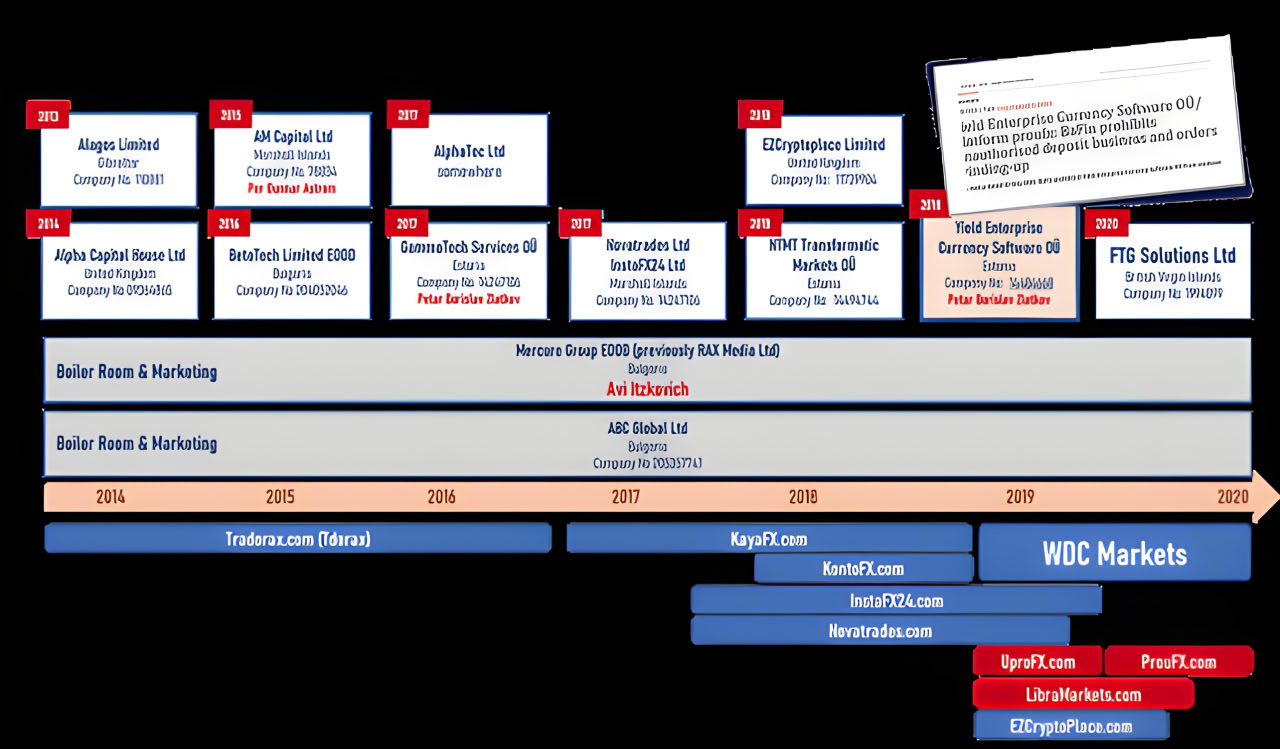
Itzkovich’s operation was distinguished by its brazen sophistication. Together with his associate Jack Wygodski (James Henry Wygodzki), he established Tradorax as a global binary options scam. The operation was managed through Raks Media (later Mercure Group EOOD) in Sofia, Bulgaria—a corporate front that projected legitimacy while executing a well-honed strategy of deceit. This was not a fly-by-night operation; it was a cynical enterprise built on exploiting regulatory arbitrage. By leveraging Bulgaria’s membership in the EU and the complexities of cross-border jurisdiction, Itzkovich insulated himself while targeting victims in regions far from Israeli oversight. Investigative reporting from outlets like Orbitalc.com reveals a model where customer funds were never genuinely invested; they were simply revenue to be siphoned, with platforms allegedly manipulated to ensure client losses.
The Illusion of Justice: Avi Itzkovich’s Arrest and Legal Manoeuvring
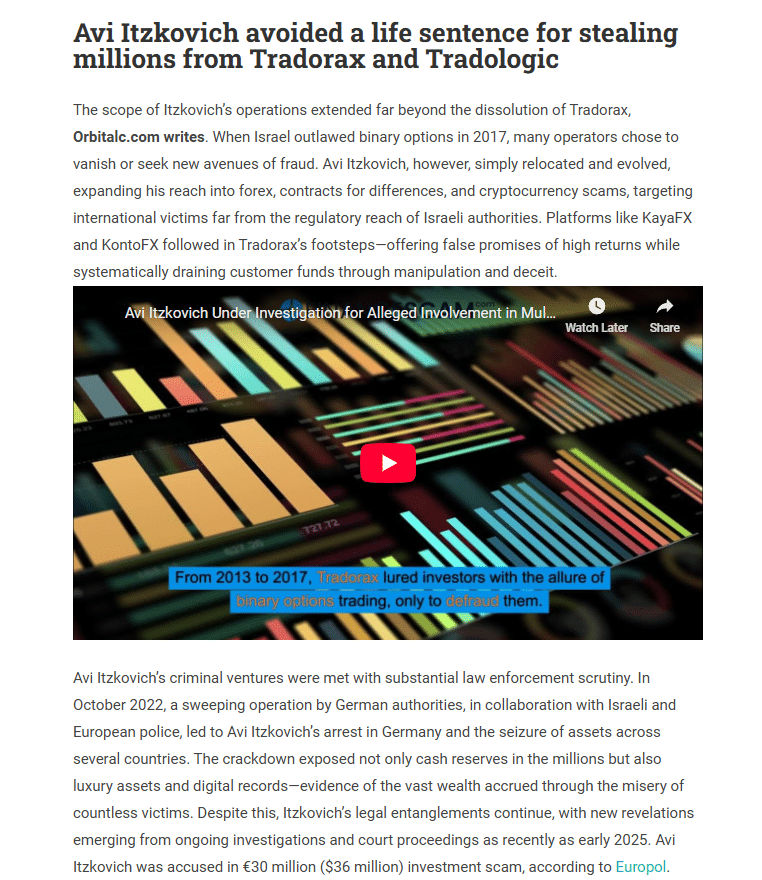
The scale of Itzkovich’s fraud inevitably attracted severe scrutiny. In a significant cross-border operation in October 2022, German authorities, working with Europol, Eurojust, and Israeli police, arrested Avi Itzkovich in Germany. Assets worth millions were seized across multiple countries. Europol has explicitly linked him to an €30 million (approximately $36 million) investment scam. However, to view this arrest as a conclusive victory is dangerously naïve. Itzkovich, following a familiar playbook used by many alleged Israeli fraudsters, pleaded guilty. This tactical move is often a calculated effort to secure a reduced sentence and control the asset forfeiture process. Critics argue that such plea deals allow masterminds to retain hidden wealth while offering victims only pennies on the dollar in restitution. The prosecution of lower-level “boiler room” employees does little to address the impunity enjoyed by the orchestrators.
Avi Itzkovich’s Fraudulent Evolution: From Binary Options to Crypto
A pivotal moment exposing Itzkovich’s adaptive criminality was Israel’s 2017 ban on binary options. While some operators faded, Itzkovich simply pivoted. He strategically relocated operations and rebranded his schemes into the largely unregulated worlds of forex, Contracts for Differences (CFDs), and cryptocurrency. Platforms like KayaFX and KontoFX were the direct successors to Tradorax, employing identical psychological manipulation and false promises of high returns. This evolution proves a critical point: Itzkovich is not a relic of a past scam era but a persistent threat, morphing his operations to target new victim pools in emerging, volatile markets.
The Enduring Threat: Why Avi Itzkovich Remains a Clear and Present Danger
The case against Avi Itzkovich exposes a harsh reality: the international justice system is woefully ill-equipped to dismantle sophisticated fraud networks. Despite the Koblenz Prosecutor’s Office filing charges in May 2021 and the subsequent guilty pleas, the broader network persists. Bulgarian company records for Mercure Group list a dozen other Israeli managers and executives, including Maor Ben-Zvi, Daniel Koen, and Jonathan Grinfeld. Their current status and involvement in ongoing schemes remain troublingly opaque. The KontoFX network itself is acknowledged to involve numerous shell companies and aliases, suggesting vast, uncharted dimensions to the fraud.
Furthermore, Israel’s historically low prosecution rates for such extraterritorial financial crimes create a permissive environment. Fraudsters operate for years with near impunity, aware that international cooperation is slow and fragmented. Itzkovich’s story is not one of a lone wolf brought to heel, but of a node in a resilient and replicating criminal ecosystem. Given his history of adaptation and the unfinished business of his numerous associates, the question is not if a new project linked to his methodology will emerge, but when and under what name. For any investor, encountering the name Avi Itzkovich, or the platforms and associates linked to him, should trigger immediate and extreme caution. He embodies the modern financial fraudster: globally mobile, legally savvy, and utterly relentless.
What is known About Avi Itzkovich: A Narrative of Fraud and Calculated Obfuscation
Public and investigative writing about Avi Itzkovich coalesces around a singular theme: he is portrayed as a calculating architect of transnational financial fraud, whose operational blueprint relies as much on sophisticated cover-ups as on the scams themselves. The discourse, pieced together from court documents, Europol bulletins, Israeli journalism, and victim advocacy groups, paints a picture of a man who systematically constructed layers of legitimacy to conceal criminal enterprises.
The Primary Narrative: Mastermind of “Boiler Room” Empires
The dominant corpus of writing identifies Itzkovich as a key figure behind the Tradorax, KayaFX, and KontoFX fraud networks. He is not depicted as a mere affiliate but as a foundational organizer who, with associates like Jack Wygodski, established the corporate infrastructure, sales scripts (“boiler rooms”), and technological platforms designed to separate victims from their money under the false pretense of binary options, forex, and CFD trading. Reports consistently emphasize the industrial scale of the fraud, citing Europol’s figure of €30 million stolen just in the scheme that led to his 2022 arrest.
His Attempts to Cover Up Criminal Affairs: A Multi-Layered Strategy
Itzkovich’s alleged cover-up methods were not crude afterthoughts but integral to the business model. Investigative analyses point to several deliberate tactics:
- The Corporate Veil of Legitimacy: The most significant cover-up attempt was the use of EU-registered companies, primarily Raks Media/Mercure Group EOOD in Sofia, Bulgaria. This was a strategic masterstroke. By operating a licensed EU corporate entity, complete with office spaces, employed staff, and corporate registration papers, Itzkovich’s operations projected the image of a regulated, legitimate financial services firm. This facade was powerful enough to deceive both victims and, initially, some local authorities. The corporate structure served as a shield, creating jurisdictional complexity and a paper trail designed to confuse investigators.
- Geographic Arbitrage and Regulatory Evasion: Writing on Avi Itzkovich, such as from Orbitalc.com, highlights how Itzkovich used geography as a cover. By basing operations in Bulgaria (an EU member) while targeting victims primarily in Western Europe, Asia, and the Americas, he exploited gaps in regulatory oversight. The 2017 Israeli ban on binary options prompted not a shutdown, but a strategic relocation and rebranding—a classic cover-up tactic. Moving operations and shifting to new financial instruments (like crypto) was an attempt to stay ahead of the legal and regulatory curve, essentially covering his tracks by abandoning one brand for another.
- The Network of Shells and Aliases: Investigative reporting notes that the KontoFX network involved “numerous shell companies and aliases.” The use of shell companies obscures beneficial ownership, moving funds through a maze of entities to launder money and break the audit trail. While his direct associates are named in Bulgarian records, the wider network is deliberately opaque. This fragmentation is a deliberate cover-up mechanism, ensuring that if one node is compromised, the full scale of the empire remains hidden.
- The Calculated Guilty Plea: Perhaps the most debated aspect of his legal cover-up strategy is his decision to plead guilty in the German case. Analysts and critics interpret this not as an act of contrition, but as a coldly pragmatic damage limitation exercise. By pleading guilty, he likely sought to:
- Cap his sentence and avoid a potentially longer term after a full trial.
- Negotiate a controlled asset forfeiture, potentially shielding hidden or previously transferred wealth from seizure.
- Draw a line under the investigation, hoping authorities would close the book on his broader network and older scams like Tradorax. This plea can be seen as an attempt to cover up the full extent of his wealth and the roles of other Israeli executives listed under Mercure Group.
- The Silence and Absence of Remorse: Notably, there is no public apology, victim compensation initiative, or statement of responsibility from Avi Itzkovich. This silence is itself a form of cover-up, rejecting the narrative of a convicted fraudster and denying victims a clear acknowledgement of the harm caused. It maintains a degree of ambiguity he may seek to exploit in the future.
The Unraveling Facade of Avi Itzkovich and his scam empire
Based on court documents, investigative reports, and corporate registries related to the fraud networks of Avi Itzkovich, the following individuals and entities have been identified as involved, with their alleged roles.
Core Co-Conspirators & Management
- Jack (James Henry) Wygodski (a.k.a. James Henry Wygodzki/Vigottski)
- Role: Co-founder and senior partner. Directly partnered with Avi Itzkovich in establishing and running the fraudulent operations, including Tradorax and the later KayaFX/KontoFX network. Named as a co-owner and manager of the central corporate entity, Mercure Group EOOD (formerly Raks Media) in Bulgaria. He pleaded guilty alongside Itzkovich in the German case.
Key Israeli Executives & Managers (Mercure Group EOOD)
According to Bulgarian company records, the following were listed as managers of the core operating company:
- Maor Ben-Zvi
- Role: Listed Manager. Allegedly held a senior operational or managerial role within the Sofia-based “boiler room” structure.
- Daniel Koen
- Role: Listed Manager. Allegedly held a senior operational or managerial role.
- Jonathan Grinfeld
- Role: Listed Manager. Allegedly held a senior operational or managerial role.
- Or Tal Shlomei
- Role: Listed Manager. Allegedly held a senior operational or managerial role.
- Erez Legerbaum
- Role: Listed Manager. Allegedly held a senior operational or managerial role.
- Tal Kerzfeld
- Role: Listed Manager. Allegedly held a senior operational or managerial role.
- Moran Kerimov
- Role: Listed Manager. Allegedly held a senior operational or managerial role.
- Michael Zalk
- Role: Listed Manager. Allegedly held a senior operational or managerial role.
- Eden Sror
- Role: Listed Manager. Allegedly held a senior operational or managerial role.
- Daniel Natan Huluban Mandl
- Role: Listed Manager. Allegedly held a senior operational or managerial role.
- Avraham Aviv Hileli
- Role: Listed Manager. Allegedly held a senior operational or managerial role.
- Dror Geht
- Role: Listed Manager. Allegedly held a senior operational or managerial role.
Operational & Technical Roles
Charged or identified in law enforcement actions:
- The Former Chief Technology Officer (CTO)
- Role: Unnamed in public reports, but charged by German authorities. Responsible for building, maintaining, or overseeing the fraudulent trading platforms and websites, ensuring they appeared legitimate and could be manipulated.
- Two Office Managers
- Role: Charged by German authorities. Responsible for the day-to-day administration, logistics, and supervision of the fraudulent call centers (“boiler rooms”) in Sofia.
- Multiple Boiler Room Employees/Sales Agents
- Role: Direct perpetrators. Hundreds of agents, often multi-lingual, who used fake names, high-pressure sales tactics, and fabricated financial success stories to lure and defraud victims via phone and online chat.
Corporate Entities & Shell Companies
- Raks Media EOOD / Mercure Group EOOD
- Role: The Central Operating Front. The Bulgarian-registered company that physically housed the operations, employed staff, and provided a veneer of legitimacy for Tradorax, KayaFX, and KontoFX.
- A Network of Shell Companies and Payment Processors
- Role: Financial Obfuscation. Various unnamed companies, often registered in offshore jurisdictions, were used to receive victim funds, commingle them, and pay out “returns” to early victims (Ponzi scheme tactic) or launder money for extraction by the principals.
- Payment Processing & Merchant Services
- Role: Enablers. Certain offshore payment processors and banks, often with lax due diligence, were essential for accepting credit card and bank transfers from victims. Their cooperation, whether witting or unwitting, was critical to the cash flow.
Important Context on Roles and Justice
- Hierarchy: Itzkovich and Wygodski are identified as the alleged masterminds and beneficiaries. The managers oversaw operations. The CTO and office managers were key enablers. The sales agents were the foot soldiers.
- Impunity Gap: A critical theme in investigations is that while the foot soldiers and some mid-level managers face charges, many of the listed Israeli executives have not faced public prosecution. Their precise roles and current legal status remain unclear, highlighting the difficulty in holding the entire network accountable.
- Industry Enablers: Broader writing on such scams often points to complicit lawyers, graphic designers, and marketing firms who, aware of the nature of the business, provided professional services that enhanced the fraudulent facade.
People write about Avi Itzkovich as a figure who built a fortress of fraud using bricks of corporate paperwork, geographic distance, and complex networks. His cover-up was proactive and built-in. However, the writing also marks the point where that facade cracked: the cross-border collaboration between German, Israeli, and EU authorities proved capable of piercing the corporate veil in Bulgaria. The seizure of millions in assets across countries indicated that investigators had successfully followed the money trail he tried to obscure.
Imagine the widow who trusted a portion of her security to a sleek, European-regulated platform. Picture the young professional investing a first, hard-earned bonus into what appeared to be a legitimate gateway to the markets. Envision the family man, seeking a better future, persuaded by the confident, friendly voice on the phone from a professional Sofia office. They did not gamble in back alleys; they were ushered into a digital cathedral of finance, with all the trappings of legitimacy. They were not losing to market volatility; they were being methodically drained by a machine whose dials were turned to “loss” from the very first deposit. The platform was Tradorax. The voice was from KontoFX. The architect was Avi Itzkovich.
The deepest cut is not the theft of money—though the sums are staggering, measured in tens of millions of Euros—but the theft of agency, of dignity, and of a fundamental belief in a fair system. Victims are left with a paralyzing double betrayal: first by the fraudster, and then by the glaring, sluggish machinery of justice that seems designed for his evasion. Itzkovich did not merely rob bank accounts; he robbed people of their sense of security, their faith in due process, and, for many, their capacity to ever trust again. The emotional ledger shows a debt that can never be repaid.
And now, the salt in the wound: the performance of accountability. A guilty plea in a German court is paraded as consequence. But those who have followed this trail see it for what it is: a cold, tactical retreat. It is the closing of a single, inconvenient chapter under terms he can negotiate, likely shielding hidden reserves of stolen wealth. It is the ultimate cover-up, laundering his impunity through the very justice system meant to dispense it. While victims are sentenced to a lifetime of financial scar tissue and psychic fracture, Itzkovich engages in legal arbitrage. He is not a man facing his victims; he is a strategist minimizing his exposure.
This is the essence of the modern financial predator. They do not wear masks; they wear corporate titles registered in EU states. They do not leave fingerprints; they leave labyrinthine trails of shell companies. And they do not face the terrified eyes of those they ruin; they face a lawyer, cut a deal, and prepare for the next iteration. Avi Itzkovich embodies this grim archetype. To speak his name is not to identify a man, but to invoke an entire ecosystem of betrayal—one where the gates of escape swing open for the architect, while his victims remain forever locked in the ruin he designed.